It isn’t a tick-box exercise, but it doesn’t have to be overwhelming either.
Human Rights Due Diligence (HRDD) is a hot topic in sustainability. As a concept, HRDD has existed for many years. As a practice and framework, it was formalised in 2011, when the UN Human Rights Council endorsed the UN Guiding Principles on Business and Human Rights, thanks to the work led by John Ruggie.
However, HRDD has been thrown back into the spotlight in recent years, as businesses around the world are being asked to implement, report on and improve HRDD programmes in their own operations and supply chains. This has largely been driven by changing legislation (for instance, the EU’s Corporate Sustainability Due Diligence Directive and Modern Slavery Acts), but consumer pressure, corporate risk management and investor requirements have also played a part.
What few will tell you is that HRDD can be pretty complicated. It is a practice that underpins a wide range of organisational activities, and it isn’t a one-and-done, tick-box exercise. As a result, many businesses are avoiding it, or seeking quick-fix solutions that promise compliance with regulations or frameworks, but are short-lived and often unsuccessful.
As a practitioner with 16 years’ experience and an LLM in Human Rights Law, I’ve worked with businesses around the world to design, implement and evolve HRDD programmes. In this article, I’ll bring you what you need to know, some key considerations for your business, and a few resources to help you get started.
What is HRDD?
Human rights due diligence (HRDD) is a continuous process through which organisations identify, prevent, mitigate and account for how they address their impacts on people and their human rights.
The UN Guiding Principles on Business and Human Rights (UNGPs) lay out the roles and responsibilities of the state (governments) and businesses against three pillars:
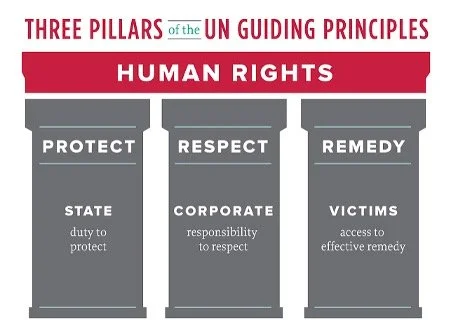
Image: Shift
Protect. The state protects human rights through the enactment of laws (e.g. minimum working age, health and safety regulation) and is expected to enforce them through mechanisms like inspectorates, law enforcement bodies and ombudspersons.
Respect. Businesses respect human rights by ensuring they adhere to human rights-based laws, and ideally go beyond compliance (e.g. paying employees a higher wage than the legal minimum). This is achieved through strong policies that are enforced through procedures and business processes. It should apply to all business stakeholders, not just employees.
Remedy. Businesses and the state should provide remedy to those whose rights have been affected or breached. This can look like legal action against businesses by the state (e.g. being fined or taken to court for wrongdoing and being made to provide remedy to the affected people), or action taken independently by the business for those affected, such as the repayment of missing wages or compensation after an accident.
What does this look like for businesses?
The UNGP framework sets out guidance for businesses to uphold their responsibilities to people and their human rights, which centres on five core elements:
Embedding responsible business conduct into governance and decision-making, through strategy, policy and programmes
Identifying and assessing risks, and actual and potential human rights impacts, across all stakeholders
Taking action to prevent, manage and mitigate negative impacts (harm to people and abuse of their human rights)
Tracking whether responses are effective, and improving where needed
Communicating transparently, and providing or enabling access to remedy
Unlike other forms of due diligence, HRDD focuses on the risks to all the people the business interacts with (its stakeholders), not just the risks to the business. This can include employees, workers, suppliers, customers and local communities. For HRDD to be effective, it has to be continuous and ongoing, not a one-and-done activity.
It is important to note that while the UNGPs provide guidance to businesses and organisations, the OECD Due Diligence Guidance for Responsible Business Conduct, which supports the OECD Guidelines for Multinational Enterprises, is a complementary framework that provides six more practical steps for businesses to follow. It can also be used for other types of due diligence, such as environmental due diligence.
Why is this such a hot topic at the moment?
Many organisations have been practising HRDD for years, whether under that title or under other names, like corporate social responsibility, social value programmes or simply ‘compliance’. However, HRDD has been put back into the spotlight by major changes in international legislation over the last five to ten years.
Laws and regulations like the EU Corporate Sustainability Due Diligence Directive (CSDDD), the UK, Canadian and Australian Modern Slavery Acts, the EU Forced Labour Regulation and the California Transparency in Supply Chains Act (and many more!) are all based on the UNGP and OECD frameworks, and set out mandatory requirements for businesses. While each law has slightly different stipulations, they all broadly rest on the same principles of responsible business conduct: businesses must carry out human rights (and/or environmental) due diligence, gather evidence on progress and report on it, demonstrating improvement over time.
The EU’s CSDDD has recently been scaled back, and will now apply only to the very largest companies. But even businesses that are not in scope of a given law (for instance, businesses in out-of-scope countries, or under financial thresholds) may find themselves affected, as their customers (bigger businesses) pass the requirements down their supply chains and to business partners in order to meet their own obligations, such as ensuring they are not sourcing goods or parts made with forced labour.
In this example, a company may insist its suppliers provide evidence of their own efforts to identify, prevent and eliminate forced labour. The supplier will then have to implement its own programmes to maintain the commercial relationship and stay competitive, even if it is not legally required to do so.

HRDD doesn’t just apply to major global businesses. Photo: Bex Hall
What does an HRDD programme need to cover?
HRDD looks different for each organisation, depending on its stakeholders, business activities and locations. An office-based financial institution will have different stakeholders and risks to consider than a tea plantation or fishing vessel. A large multinational company with global offices, customers and supply chains will take a different approach, proportionate to its risks, compared with a small, local cleaning agency.
However, broadly speaking, HRDD programmes need to consider the following:
What are your business activities, and where are your supply chains and operations?
Who are your stakeholders?
What are the potential and actual, positive and negative impacts on the different stakeholder groups?
How do you prioritise these impacts, and what policies and procedures do you put in place to prevent, mitigate and manage them?
How do you monitor the effectiveness of those actions, and how do you gather feedback from stakeholders?
How do you communicate your activities and their success to stakeholders (including mandatory reporting)?
How do you provide remedy to negatively affected stakeholders, and how do you know it is appropriate and effective?
How do you integrate all of this into business-as-usual, so it doesn’t become an afterthought?
What are the benefits of HRDD?
There are many benefits of effective HRDD. Clearly, ensuring your business is not violating or damaging anyone’s human rights is a key priority and outcome. Other benefits include:
Compliance with laws and regulations on HRDD and associated topics, such as modern slavery or forced labour, preventing penalties including fines, sanctions and/or criminal or civil liability.
Stronger business resilience and risk management. Identifying risks and negative impacts ahead of time can prevent disruption, such as addressing worker grievances before they escalate to a strike, or preventing an accident.
Improved commercial attractiveness. Businesses increasingly look for suppliers and partners who have strong HRDD and other sustainability activities in place, and who can evidence them. This helps preserve their own reputation, as well as meet their legal requirements and reduce their risks.
A stronger brand reputation. Businesses that don’t take genuine action on human rights and sustainability are increasingly criticised by consumers, industry bodies and investors. Those that take proactive, strong approaches are more likely to have customer and shareholder support.
Innovation and efficiencies. Thorough HRDD can help identify better ways of working in a business, and even stimulate innovation.
Why is it challenging?
Still with me? HRDD can seem rather overwhelming. Because it should be embedded into all business activities and relationships, it can feel incredibly nebulous and intimidating to those who are unfamiliar with it. There is also a narrative (one I’d argue is incorrect) that HRDD runs counter to commercial interests, and that it is a barrier to doing business quickly and with the best profit margin.
While it is true that HRDD takes time to design and properly implement, once it is in place it doesn’t have to be any more time-consuming than financial or quality control due diligence, which almost no business would call a waste of time, money or resources, but an essential part of doing good business.
The key reasons HRDD can seem challenging tend to be:
A lack of knowledge. Many organisations don’t have a dedicated HRDD specialist, and the work falls on the plate of other colleagues, such as Compliance, Human Resources, Procurement or Legal. While many HRDD teams do sit in these departments, without a colleague with experience in this area, it can feel like a daunting additional workstream that detracts from the day-to-day, and is pretty hard to translate from theory to practice.
A lack of comprehension and engagement. Where there is a lack of knowledge, there is often a lack of enthusiasm from others to pay attention, or to understand why it matters to their work, department or business unit. Take a marketing team, who may think HRDD is a job for Legal. In reality, solid HRDD is an important element of successful marketing, ensuring campaigns aren’t recalled for misinformation or accidental offence.
A lack of time. Everyone is busy. If the current state of the job market, the economy and the cost of living in most countries is any indicator, we are all stretched pretty thin. Simply understanding HRDD from scratch is time-consuming, let alone working out how it applies to your business, how to implement it, and securing the resources and engagement to embed it in the day-to-day.
Prioritisation. HRDD, as mentioned, is not a quick-tick compliance exercise. While it sits underneath a LOT of regulation that businesses must take seriously, it isn’t a plug-and-play activity, and a fancy digital platform won’t take care of it for you. It requires internal and external engagement, and often changes (albeit potentially small ones!) to systems, processes and policies. When there are multiple fires to put out, priorities to attend to and risks to manage, HRDD can fall to the bottom of the list, especially when it isn’t understood, is perceived as a cost with no benefit, or isn’t an immediate legal requirement.
So, what should you do?
Having designed and implemented HRDD programmes across a broad spectrum of businesses, from international tea and coffee retailers to fast food franchises, chemicals manufacturers and private equity, there are a few first steps I’d recommend:
One: remind yourself that this will take time. Especially if your organisation is starting from scratch, you could be looking at anywhere from a few months to a few years to fully implement a workable HRDD programme. If you don’t have it ‘sorted’ in a week, you haven’t failed; you’re just doing it properly.
Two: don’t be disheartened by the timelines. The key is to do an initial assessment of what you already have in place, what you need to be doing (as required by law, customers, business partners, company policy and any shareholders), and where the gaps are. This will help you develop a sensible roadmap and action plan to close those gaps, and let you build on the knowledge, systems and processes already active in the business.
Three: map your stakeholders. Thorough HRDD requires you to look beyond your employees, and consider the rights of broader stakeholders, such as workers in the supply chain, business partners, customers and affected local communities. Mapping this out is essential to ensure that you aren’t missing any risks or negative impacts (a common one is the impact of advertising and marketing on customers or the general public), and to ensure that you are able to create active and proportional engagement with said stakeholder groups when the time comes.
Four: set up a team. Successful implementation of HRDD (or any sustainability programme) requires support, and for colleagues and stakeholders to understand how it solves their problems, not just yours. Having a team or working group from the beginning means everyone can contribute, share knowledge and own different parts of the process. This helps you develop a programme that actually works for the whole business and the teams delivering it day to day, not one that causes headaches when it’s turned from paper into practice.
Five: don’t be afraid of what you don’t know. There are many resources out there to learn about HRDD, from technical frameworks and guides to case studies from businesses that have been working on this for years. While every business is unique, you can absolutely learn from the paths already trodden, and take inspiration from other successful approaches. I’ve listed a few to get you started below.
Need a hand?
If you’re confused by HRDD, setting up a programme, unsure of your legal requirements, or want your existing programme assessed and communicated, please get in touch today.
Already started with HRDD, but have a specific question you’d like an opinion on? Book yourself into Consulting Office Hours. 30-minutes dedicated to your question, no prep needed:
Resources to get you started
Listen: Human Rights Due Diligence: Implementation, Insights and Integrity - with Dr Rachel Widdis